

Summary:
Most people don’t think about land surveyors until they suddenly need one — and they need one fast. A closing date is approaching, a contractor is ready to break ground, or the Town of Hempstead is asking for a certified survey before they’ll issue a permit. At that point, the temptation is to call the first name that comes up and move on.
But not everyone who calls themselves a land surveyor is actually licensed to practice in New York State. And if you hire someone who isn’t, the survey they produce won’t be worth the paper it’s printed on. Here’s what you actually need to know before you hire.
Registered Professional Land Surveyor Requirements in New York State
New York State takes land surveyor licensing seriously. Under Article 145 of the NYS Education Law, it is illegal to practice land surveying — or even use the title “land surveyor” — without an active license issued by the state. That’s not a technicality. It’s the law, and it exists because the stakes are real.
To earn a license, a candidate must accumulate a minimum of eight years of combined education and experience, pass a 14-hour national examination called the Fundamentals of Land Surveying, and pass a separate New York State-specific exam covering local practice standards. Once licensed, surveyors must complete 24 hours of continuing education every three years just to keep that license active. As of 2020, there were only 1,098 active licensed land surveyors in all of New York State — a deliberately small, highly qualified group.
What Does a Registered Professional Surveyor Actually Do on Your Property?

A registered professional surveyor doesn’t just show up with equipment and walk your yard. The process starts before anyone sets foot on your property. We research deed records, prior surveys, and municipal archives to understand your property’s legal history. In Nassau County, where the average single-family home is 73 years old and property records in some areas date back to 17th-century land grants, that research phase is anything but simple.
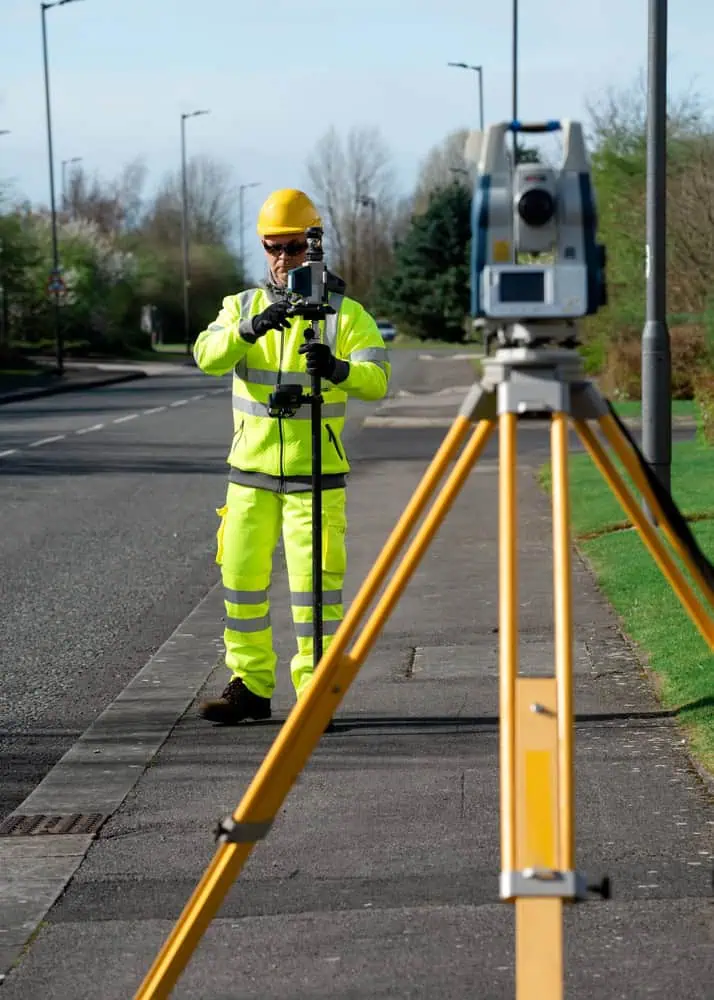
From there, our field crew uses GPS equipment, total stations, and digital measurement tools to physically locate property corners, measure dimensions, and document what’s on the ground. Every measurement ties back to established legal references — not estimates, not approximations.
Once the fieldwork is done, we review and certify the findings. That certification stamp is what makes the document legally recognized. Without it, title companies won’t accept it, mortgage lenders won’t approve it, and Nassau County building departments won’t process your permit. That stamp can only come from someone who holds an active New York State license — which is exactly why verifying credentials before you hire isn’t optional, it’s essential.
The practical difference between a licensed surveyor and someone operating without credentials isn’t just legal exposure. It’s the depth of local knowledge, the accuracy of the research, and the accountability that comes with professional licensure. If something goes wrong with our work, there’s a clear path to recourse. With an unlicensed provider, you’re largely on your own.
How to Verify a Land Surveyor's License in Nassau County, NY
Verifying a surveyor’s credentials in New York State is straightforward — if you know where to look. The New York State Office of the Professions maintains a public license lookup database at op.nysed.gov. You can search by name, license number, or business name and confirm in seconds whether a surveyor holds an active, valid license.
Before hiring anyone, ask for their license number directly. A legitimate professional will give it to you without hesitation. If someone deflects or can’t produce one, that’s your answer.
Beyond the license itself, ask whether they carry professional liability insurance — also called errors and omissions insurance. This protects you if a mistake in the survey leads to a financial loss. General liability insurance matters too, covering any accidental property damage during fieldwork. Reputable firms carry both. The absence of either is a documented red flag across the industry, and in Nassau County where homes are selling at a median of around $800,000, the cost of an uninsured error could far exceed what you saved on a cheaper quote.
It’s also worth asking how long the firm has been operating locally. A surveyor who has been working in Nassau County for decades has navigated the permit offices of the Town of Hempstead, the Town of North Hempstead, and the Town of Oyster Bay — three separate municipal structures, each with its own zoning codes and submission requirements. That institutional knowledge doesn’t appear overnight, and it has real practical value when your permit is on the line.
Different Types of Land Surveys and What Each One Is Actually For
One of the most common points of confusion for property owners is simply not knowing which type of survey they need. The answer depends entirely on what you’re trying to do — and getting it wrong can mean delays, rejected applications, or having to pay for a second survey.
We provide several distinct survey types, each serving a different purpose. Understanding the difference upfront saves time and avoids miscommunication with your contractor, attorney, or municipality.
Boundary Surveys, Title Surveys, and Topographic Surveys — What's the Difference?
A boundary survey is what most homeowners picture when they think of land surveying. It establishes the precise legal limits of your property — where your lot begins and ends, where the corners are, and what the exact dimensions are. If you’re installing a fence in Syosset, adding an addition in Garden City, or settling a property line dispute with a neighbor in Westbury, a boundary survey is where you start. We research your deed, locate existing monuments or markers, and place stakes at your property corners so there’s no ambiguity.
A title survey — sometimes called a mortgage survey or location survey — is what your real estate attorney or title company will request during a property transaction. It documents the property’s dimensions, structures, and any visible encroachments or easements, and gives the title company what they need to issue title insurance. If you’re buying or selling a home in Nassau County, expect this to come up. Given that homes here are moving in an average of 23 to 32 days, you don’t want to be scrambling for a survey at the last minute.
A topographic survey serves a different purpose entirely. Rather than focusing on legal boundaries, it maps the physical characteristics of a property — elevation changes, contour lines, drainage patterns, and the location of existing structures. Architects and engineers rely on topographic surveys when designing new construction or major additions. If you’re planning a significant project, your design team will likely ask for one before they can finalize plans.
There are also elevation certificates, which are FEMA-required documents that establish a structure’s lowest floor elevation relative to the base flood elevation in your area. For property owners in Nassau County’s South Shore communities — Long Beach, Oceanside, Freeport, Atlantic Beach — these certificates are directly tied to flood insurance rates and, in many cases, are legally required. After Hurricane Sandy reshaped FEMA’s flood zone maps for much of Long Island, demand for elevation certificates in Nassau County has remained consistently high.
Hiring a Private Land Surveyor in Nassau County: What to Ask Before You Commit
Once you understand what type of survey you need, the next step is finding the right private land surveyor to do the work. The questions you ask before hiring matter as much as the credentials themselves.
Start with turnaround time. This is consistently the number one frustration buyers in this market express. Surveyors routinely quote four to seven weeks for completion — and some don’t deliver even then. If you have a closing date, a permit deadline, or a contractor scheduled to start, that timeline can kill your deal or delay your project. Ask for a specific, written estimate of when the work will be completed, not a vague range.
Ask whether the firm handles both original surveys and updates. This matters more than it sounds. Many Nassau County homeowners discover they need an updated survey when they’re already mid-transaction or mid-project. If the company that performed your original survey can also handle the update — and already has your property’s history on file — you avoid the cost and delay of starting from scratch with someone new.
Ask about local experience, specifically. A surveyor who has been working in Nassau County knows the quirks of local deed records, the submission requirements of individual building departments, and the practical realities of surveying in a densely developed suburban county where property lines are tight and the stakes of an error are high.
Finally, ask for a written estimate before any work begins. A reputable firm will provide one without hesitation. Price transparency is a basic professional courtesy — and in a market where survey costs can vary significantly based on property size, location, and survey type, you deserve to know what you’re paying for before you commit.
Choosing the Right Registered Professional Surveyor in Nassau County
The credential isn’t a formality. In New York State, a licensed land surveyor has cleared a high bar — years of education and experience, rigorous examinations, ongoing continuing education — and they carry the legal authority to certify documents that courts, lenders, and municipalities will actually accept. Hiring someone without that credential doesn’t save you money. It creates risk.
Nassau County’s property market moves fast, the homes are old, and the regulatory environment across the Town of Hempstead, North Hempstead, and Oyster Bay is genuinely complex. You want someone who knows this county — not just land surveying in general.
We’ve been serving Nassau and Suffolk County for over 50 years, hold a 5-star Google rating, and average an 8-day turnaround. Reach out for a free, no-obligation quote and find out what a survey on your property actually involves.